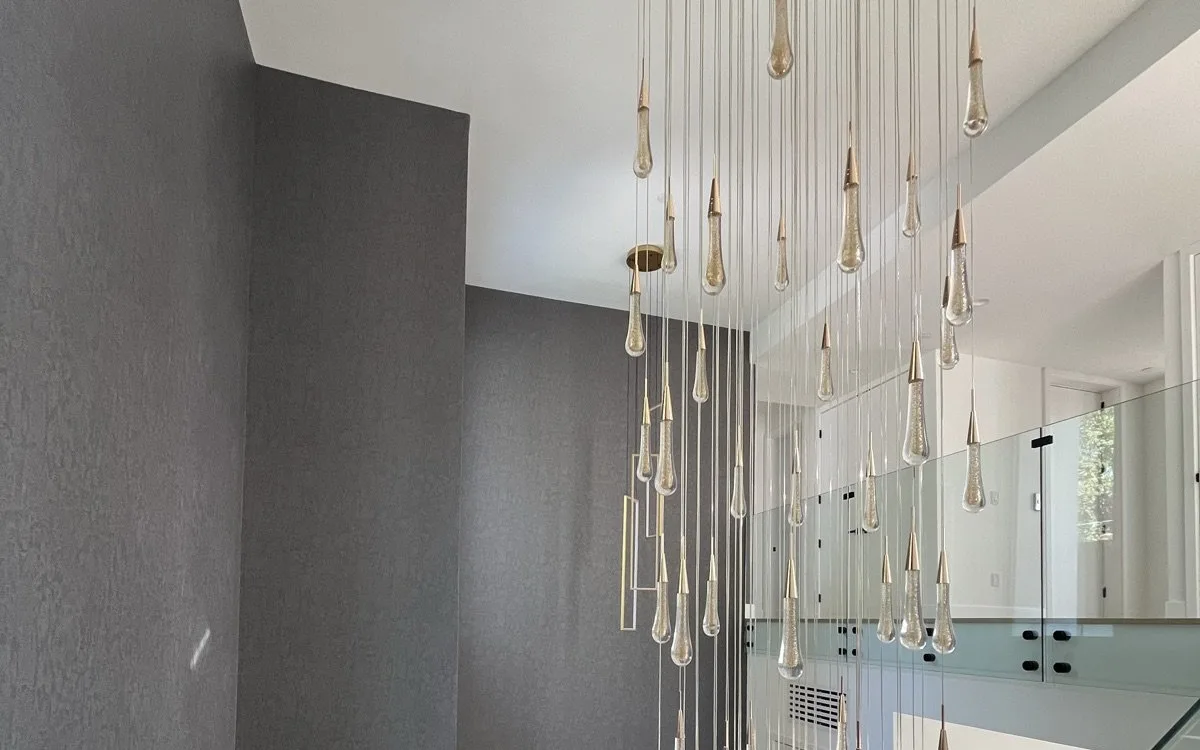
When a renovation opens up a center-hall foyer or creates a two-story staircase void — whether through a second-story addition, a staircase reconfiguration, or a whole-home renovation — the lighting decision that follows is unlike any other in the home. Standard residential fixtures don't scale to a double-height space. The ceiling is 18, 20, or 22 feet above the finished floor. The chandelier or pendant cluster has to read at that height and still feel proportionate from the ground. Getting this wrong — too small, too low, wrong style, wrong mounting — produces a result that photographs poorly and feels off every time someone walks through the door. Here's what the selection and installation process actually involves.
Why Double-Height Spaces Are a Distinct Lighting Problem
Most lighting rules of thumb assume a standard 8- or 9-foot ceiling. In a two-story foyer or staircase void with a ceiling height of 16 to 24 feet, those rules produce undersized, underwhelming results. The fixture that would look substantial in a standard dining room — a 24-inch chandelier at 8 feet — becomes a small ornament at 20 feet. The scale relationship between fixture and space is completely different.
The second challenge is visual weight at distance. A fixture viewed from 18 feet below must have enough visual density — number of elements, brightness, physical diameter — to register as a purposeful design choice rather than a placeholder. Cascading multi-pendant fixtures, which distribute their visual mass across a vertical drop, address this better than a single-element chandelier, which can appear lost in a tall void even at a large diameter.
The third challenge is the installation itself. Mounting a fixture that may weigh 40 to 150 pounds, at a ceiling height that requires a lift or scaffolding to reach, on wire drops that may run 12 to 18 feet, requires coordination between an electrician, a carpenter (for ceiling blocking), and sometimes a specialty lighting installer who works with high-drop configurations regularly.
Fixture Types for Two-Story Voids
Several fixture categories work well in double-height foyers and staircase voids:
- Cascading multi-pendant clusters: Individual pendant elements — glass drops, blown glass globes, crystal rods, or geometric forms — suspended from a common canopy at varying lengths to create a cascading cloud of light. The canopy mounts to the ceiling, and the individual pendants hang anywhere from 6 to 20 feet below it. The visual effect is a column or cloud of light that fills the void without requiring a single massive fixture. This is the most common format in contemporary renovations in the DMV: it reads as modern and architectural, scales naturally to the ceiling height, and allows custom configurations in terms of the number of elements and their drop arrangement.
- Large-format statement chandelier: A traditional chandelier form — arms, shades, or crystal — in a diameter sized for the space. For a standard two-story foyer (roughly 10 × 10 feet at the ceiling), a chandelier in the 36- to 48-inch diameter range is the starting point; larger spaces warrant 54 to 72 inches. These fixtures are heavy and typically require engineered ceiling blocking (a structural box installed in the ceiling framing to support the weight load), plus a canopy-to-fixture downrod long enough to bring the fixture to the correct hanging height.
- Linear suspension systems: A horizontal bar or frame with multiple pendant arms, hung from two or three cable attachment points at the ceiling. These work well in rectangular foyer plans or above a staircase where the void is elongated rather than square. The linear form references furniture scale and can be sized to match the plan dimension of the space below.
- Single large sculptural pendant: A single pendant element — a woven rattan sphere, a large paper lantern form, a custom fabricated shade — at a very large diameter (36 to 60 inches). These work in lower-vaulted spaces or where the foyer plan is compact; in a full two-story void, a single element must be very large and visually dense to avoid looking undersized.
Scale Rules for Two-Story Fixtures
There is no single formula, but several guidelines are widely used by lighting designers for double-height spaces:
- Diameter relative to floor footprint: Add the length and width of the foyer in feet, then convert to inches for a starting-point diameter. A 10 × 10-foot foyer suggests a 20-inch fixture minimum — but in a two-story void, most designers recommend starting at 1.5 to 2 times that value (30 to 40 inches) to account for the increased visual distance from floor to fixture.
- Hanging height: For a foyer or entry, the standard recommendation is to hang the bottom of the fixture 7 feet above the finished floor if there is a door or traffic passing underneath, or lower if it is a purely decorative void with no passage beneath. For a staircase void, the bottom of the fixture should clear the highest stair tread or landing by at least 7 feet. With a 20-foot ceiling height and a 7-foot clearance requirement, the fixture body can run 13 feet of vertical drop — which is why cascading multi-pendant configurations are so common: they can fill that 13-foot drop with visual interest rather than a bare downrod.
- Visual mass: In a very tall void, a fixture that is dimensionally correct but visually light (thin wire arms, minimal elements) will still look undersized. Visual mass — the density and brightness of the fixture as seen from below — should be calibrated alongside physical scale. Multi-element fixtures build visual mass through quantity; a single pendant builds it through form and diameter.
Installation Engineering: What a Two-Story Fixture Requires
The installation of a statement fixture in a two-story void differs substantially from a standard chandelier replacement:
- Ceiling structural blocking: Most residential ceiling framing is designed to carry drywall and standard light fixtures, not a 60- to 150-pound decorative fixture with a long lever arm. Before a heavy fixture is installed, a carpenter or framer needs to install a structural blocking box — a platform of doubled lumber or plywood between ceiling joists — at the mounting location. The blocking transfers the fixture's load directly to the framing rather than through the drywall. This is a prerequisite, not an optional upgrade, for any fixture over approximately 35 pounds.
- Electrical rough-in and wire management: Long wire drops require that the fixture's wire (or the installer's supply wire) be routed cleanly from the canopy to the individual pendant elements without visible bundling or slack. Custom fixtures typically supply wire coils of specific lengths; the installer adjusts drop heights during installation. The junction box in the ceiling must be rated for the fixture weight; standard pancake boxes are not.
- Dimmer compatibility: LED-based fixtures, which are now universal for multi-pendant configurations (for heat and energy reasons — see below), must be paired with a dimmer that is compatible with their LED driver. Phase-cut dimmers (standard TRIAC) often flicker or buzz with LED fixtures. Leading-edge or trailing-edge dimmers matched to the fixture's LED driver are the correct specification; the fixture manufacturer's compatibility list is the starting point, and an electrician can test at rough-in before drywall is closed.
- Access for installation: At 18 to 22 feet, a ladder is insufficient and unsafe. A scaffold tower or scissor lift is the standard tool. For renovations in the DMV where foyer access is through a finished entry, this means planning the lift staging around the finished floor (protection required) and the staircase landing (weight limits matter). Some specialty lighting installers own their own lift equipment; others rent. Either way, the installation day requires dedicated access and protection for the finished space.
LED for Long Drops: Why It Matters
Incandescent and halogen sources generate significant heat at the bulb base. In a cascading multi-pendant fixture where dozens of pendants hang at different heights on long wire drops, heat builds up at the canopy and in the wire bundle above the pendant cluster. LED sources, which generate a fraction of the heat of incandescent at equivalent lumen output, are the appropriate specification for any multi-element long-drop fixture — not primarily for energy reasons, but for safety and performance reasons. Heat accumulation in a wire bundle at ceiling height, surrounded by insulation and framing, is a fire risk over time. LED also extends the replacement interval significantly: in a fixture that requires a lift to service, a lamp life of 25,000 or 50,000 hours is a maintenance advantage.
For fixtures where the lamp is a decorative element (Edison-style filament bulbs, for example), there are LED versions that closely replicate the visual quality of incandescent with a fraction of the heat output. These are the correct specification for any visible-bulb application in a two-story fixture.
Bulb Replacement and Maintenance at Height
This is the most frequently underestimated consideration in the selection process. A fixture that requires annual bulb replacement or biannual cleaning, at a ceiling height that requires a lift to access, will impose a recurring maintenance cost and scheduling burden. The practical mitigation:
- LED sources with long rated life: Specifying fixtures with 25,000-hour or greater LED life reduces replacement frequency to once a decade or more under typical use.
- Integrated LED modules vs. replaceable bulbs: Integrated LED fixtures have no user-replaceable lamp — when the module fails (typically after 25,000+ hours), the module itself is replaced. Fixtures with standard-base LED bulbs (E26 or GU10) allow individual bulb replacement without module sourcing. Either approach is workable; the key is sourcing a fixture from a manufacturer that will still be in business and stocking replacement parts when service is needed in 10 to 15 years.
- Annual wipe-down: Dust accumulation on pendant elements reduces lumen output noticeably over time, particularly for glass-encased LED elements. An annual wipe-down with a damp microfiber cloth (with the circuit off at the breaker) maintains output and appearance; scheduling this with the fixture installer or a cleaning service that brings appropriate equipment is the practical approach.
DMV Foyer Context: Colonial Homes, Townhouses, and New Construction
The two-story foyer is a common feature across three residential types prevalent in the DMV:
- Colonial and center-hall single-family homes: Many colonials in Montgomery County, Fairfax, and DC's inner suburbs were built with a single-story foyer and a standard 8- or 9-foot ceiling in the entry. Renovations that open the ceiling to the floor above — removing the second-floor hallway ceiling to expose the full void — are a common move in whole-home renovations. This change requires structural work (the ceiling joist line above may carry load from the second floor) and creates the two-story void from a previously standard entry.
- Townhouses and rowhomes: Many townhouses in Bethesda, Arlington, and DC were built with a central staircase that opens to a stairwell void. Staircase renovations — replacing balusters, upgrading railings to cable or glass panels, refinishing treads — often include a chandelier upgrade as part of the same scope, since the finished staircase needs a lighting focal point that matches the new railing language.
- New construction and additions: Second-story additions and whole-home gut-renovations in the DMV frequently include a planned two-story void at the entry or staircase as a design feature. In these cases, the fixture selection happens during the design phase and the rough-in is sized and located for the planned fixture — the blocking, wiring, and junction box are all coordinated before any ceiling is closed.
What Two-Story Foyer Lighting Installations Cost in the DMV
- Cascading multi-pendant chandelier fixture, 30–60 elements, mid-range manufacturer: $1,500–$5,000 for the fixture
- Cascading multi-pendant, custom or high-end (Restoration Hardware, Visual Comfort, Currey & Company, or custom fabrication): $4,000–$20,000+ for the fixture
- Large-format traditional chandelier (36–60" diameter): $800–$8,000 depending on crystal content, arm count, and tier
- Ceiling structural blocking installation: $300–$800 (carpenter, 2–4 hours)
- Electrician installation including dimmer, new circuit, and wire management: $600–$1,500 depending on access and existing rough-in
- Scissor lift or scaffold rental for installation day: $200–$600 depending on height and duration
- Complete installation (blocking, electrical, lift, installation labor): $1,200–$3,000 in labor and access costs, excluding fixture
These ranges are planning figures. Actual costs depend on ceiling height, existing rough-in, junction box condition, structural blocking requirements, and access logistics in the specific home.
Ready to Plan Your Foyer Lighting?
Donya LLC is a Maryland home improvement contractor based in Bethesda (MHIC #159903). Project availability outside Maryland depends on applicable local licensing, trade, and permit requirements. Our interior renovation service includes structural coordination for ceiling blocking, electrical rough-in and trim-out, and specialty fixture installation as part of a whole-home or targeted renovation scope. Call (301) 337-9445 or email Reza@donyallc.com to discuss your foyer renovation project.