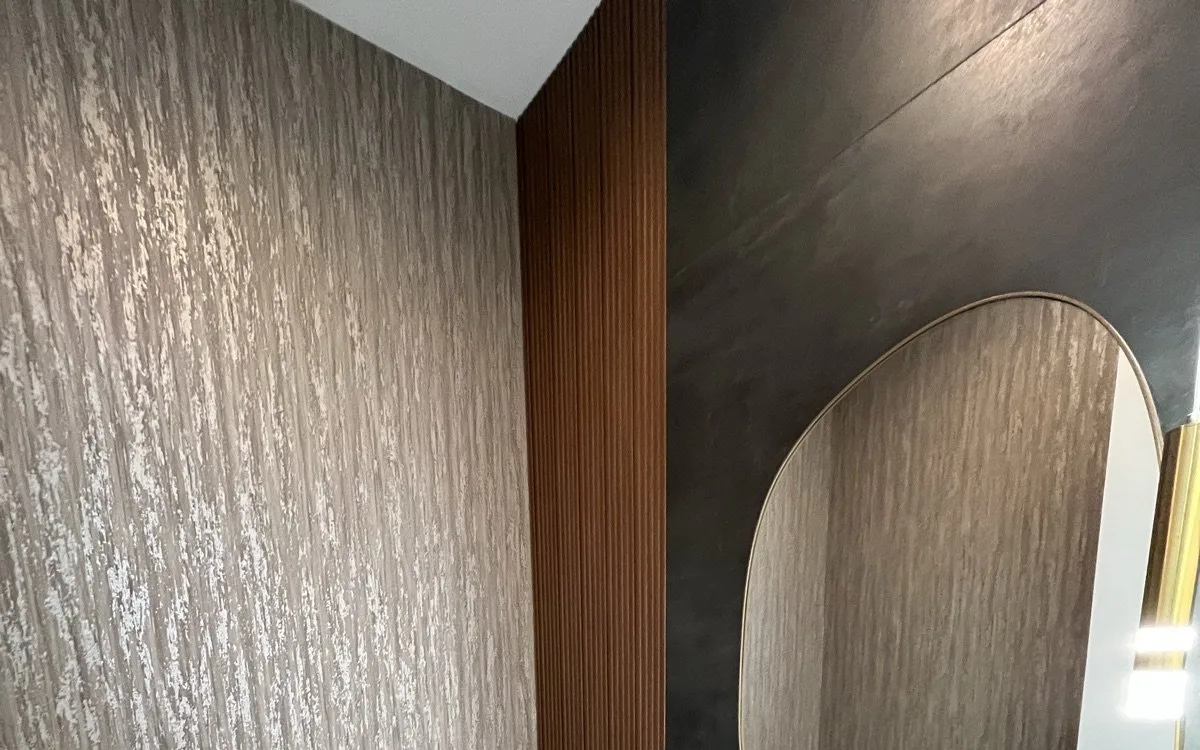
Paint is the default wall finish in American residential construction — and for most rooms in most homes, it's the right answer. But a subset of rooms benefit from wall treatments with more physical presence than paint can provide: texture, depth, light-catching variation, and a handcrafted character that reads as deliberately different from the standard flat or eggshell coat. In the DC, Maryland, and Virginia renovation market, several applied finish techniques have seen growing demand — particularly for powder rooms, primary suite accent walls, and living room focal surfaces. Here's what each technique actually is and what distinguishes one from another.
Venetian Plaster
Venetian plaster (also called polished plaster or marmorino) is a multi-coat application of slaked lime putty mixed with marble dust, troweled onto the wall in thin layers and burnished to a smooth, semi-reflective surface. The technique has been used in European interiors since the Renaissance; the name comes from its association with Venetian palazzo interiors, where polished plaster walls created a visual effect resembling polished stone at a fraction of the cost.
The characteristic of Venetian plaster that distinguishes it from paint is translucency. Each troweled layer is thin enough that light penetrates slightly and reflects from previous layers, creating visual depth that paint cannot achieve — the surface seems to glow rather than simply reflect. The degree of polish is controlled by the applicator: more burnishing produces a higher sheen and more marble-like character; less burnishing produces a matte surface with visible trowel texture.
Venetian plaster is applied over properly primed drywall or existing plaster, requires 2–5 coats depending on the specified finish, and cures over several days. Cost: $8–$20 per sq ft applied, depending on the number of coats, sheen level, and complexity of the room.
Limewash
Limewash is a water-based paint made from slaked lime — a much thinner, more fluid material than Venetian plaster. Where Venetian plaster is built up in layers to achieve a polished stone character, limewash is brushed on in overlapping, slightly transparent coats that produce a mottled, aged, Mediterranean character. The finish is intentionally uneven — streaks and variations in coverage are part of the look, not imperfections to be minimized.
Limewash has been applied to interior and exterior masonry in Europe for centuries; its current residential popularity in the US tracks with broader demand for textured, lived-in aesthetics that push back against the uniformity of standard latex paint. Brands like Portola Paints have introduced water-based formulas that apply similarly to traditional limewash but without the caustic handling requirements of pure lime. Cost: $4–$10 per sq ft applied; closer to an advanced paint application than a specialty plaster trade.
Microcement and Concrete Overlay
Microcement is a polymer-modified cementitious coating applied in thin layers (2–3mm total) over existing substrates — drywall, tile, concrete, or wood. It produces a seamless, matte concrete-look surface across walls, floors, and even cabinetry faces, all from the same material. The appeal is the monolithic character: a microcement bathroom, for example, can have the same surface running continuously from wall to floor to ceiling with no grout joints or transitions, which reads as an architectural statement rather than a material assembly.
The technical requirements for microcement are significant: the substrate must be structurally sound and properly prepared, the coating must be sealed with multiple coats of topcoat appropriate for the surface's use (a floor receives a different sealer than a wall), and the applicator must be trained in the material's behavior. A poorly applied microcement floor will crack and delaminate; a well-applied one is extremely durable. Cost: $12–$25 per sq ft for walls; $18–$35 per sq ft for floors, which carry higher durability requirements.
Metallic and Textured Specialty Coatings
A broader category of applied finishes uses metallic pigments, aggregates, or wax additives mixed into a base material to produce surfaces that catch light differently from flat paint. These range from iron-effect coatings (where actual iron particles are introduced and then oxidized to create rust patterns) to pearl and mica finishes that shift in appearance with viewing angle to the high-sheen metallic trowel finish seen in contemporary powder rooms and hotel lobbies.
Applied specialty coatings are almost always faux finishes in the technical sense — they simulate the character of other materials (burnished metal, raw plaster, stone) through applied chemistry rather than the actual material. The quality range is wide: a skilled decorative painter can produce results indistinguishable from the real thing; a poorly executed metallic finish looks theatrical in the wrong way. Vet the applicator's portfolio before committing to this category. Cost: $10–$30 per sq ft, highly variable based on technique complexity.
Where These Finishes Work Best in DMV Homes
- Powder rooms: The highest-impact application for any specialty finish. Small square footage means the material cost is manageable ($500–$1,500 for most techniques in a standard powder room) while the visual effect is concentrated and memorable.
- Primary bedroom accent walls: A single wall in Venetian plaster or limewash behind the bed creates a headboard effect without furniture.
- Home office focal walls: A textured or polished plaster surface behind a desk reads as intentional and distinctive in video calls.
- Living room fireplace surrounds: Microcement applied to a fireplace surround wall creates a seamless, contemporary look that complements stone or tile inserts.
- What to avoid: Venetian plaster and limewash perform poorly in areas with direct water contact — a wet shower wall requires a waterproof substrate system, not a lime-based finish. These are dry-area treatments. Microcement with proper sealing can handle wet applications.
Ready to Add a Specialty Finish to Your Renovation?
Donya LLC is a licensed and insured design-build contractor serving Washington DC, Maryland, and Northern Virginia (MHIC #159903). Our interior renovation service includes coordination of specialty finish applicators as part of bathroom, powder room, and living space renovations. Call (301) 337-9445 or email Reza@donyallc.com to discuss your project.