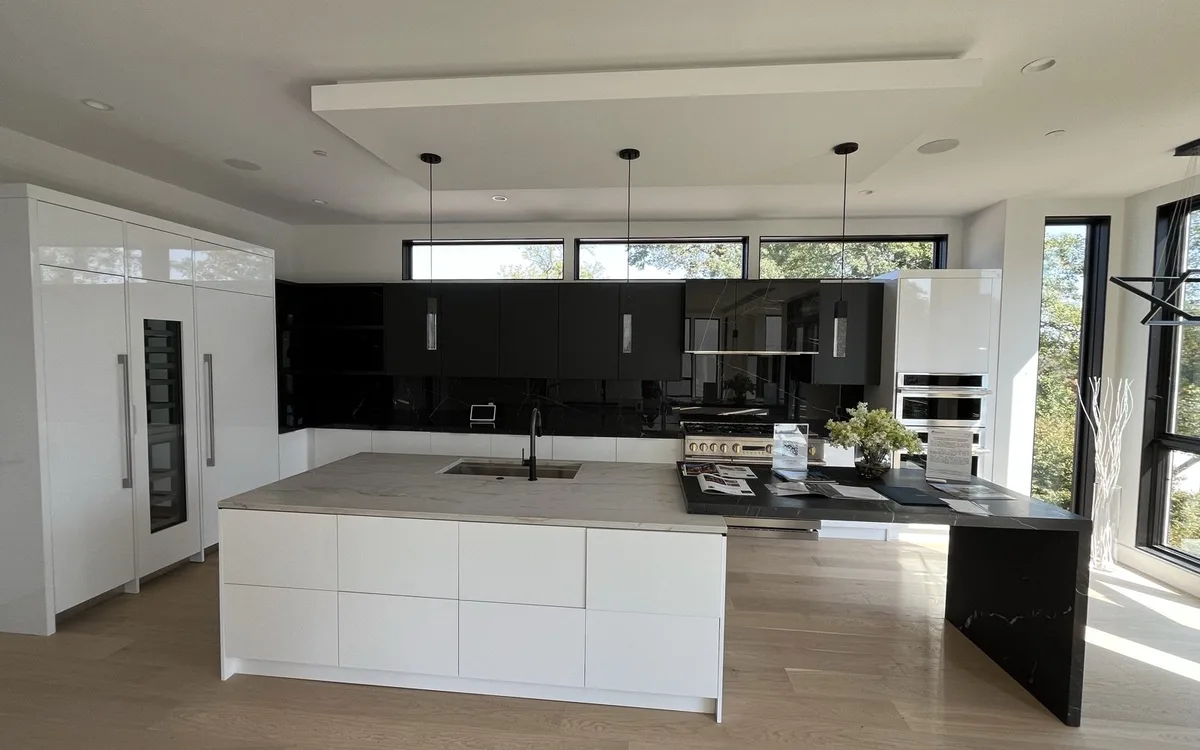
The kitchen cabinet market has changed significantly in the past decade. The frame-and-panel door with a recessed center panel — the dominant style of American kitchens from the 1980s through 2010s — now competes directly with flat-front, slab-door, and handleless cabinet options that were once associated only with high-end European kitchen manufacturers. In the DC, Maryland, and Virginia market, these contemporary styles have moved into renovations at all budget levels. Here's what the options actually are, how they differ in durability and cost, and what makes each appropriate for a given space.
Door Styles: The Foundation of the Look
Cabinet door style — not the finish color — is the primary visual driver of a kitchen's character:
- Flat-front (slab) doors: A single piece of material — wood veneer, MDF, thermofoil, lacquer, or acrylic — with no center panel, no routed detail, and no decorative profile. The look reads as clean, minimal, and contemporary. Flat-front doors are unforgiving of warping (a slight bow becomes very visible) and require higher-quality substrate materials and construction tolerances than frame-and-panel doors, which flex and expand as wood intended.
- Shaker (recessed panel): The dominant "transitional" door style — a flat center panel with a simple square-edged rail and stile frame. Less historically period-specific than a raised-panel door, Shaker works across a range of aesthetics from farmhouse to contemporary. The interior corner of the frame collects grease and requires more cleaning effort than a flat-front slab.
- Inset doors: The door sits flush inside the cabinet frame rather than overlapping it. This is the most precise and expensive cabinet construction method — tolerances are tight and movement from seasonal humidity (significant in the DMV) must be designed into the gap — but the result is a very refined, furniture-quality appearance.
Finish Options for Contemporary Kitchens
The finish material applied to a flat-front or shaker door determines durability, maintenance, and cost:
- Painted MDF: A medium-density fiberboard substrate with a sprayed paint finish is the standard for painted cabinet doors. MDF is dimensionally stable (it doesn't move with humidity the way solid wood does) and accepts a smooth, flat paint coat without grain telegraphing through. The vulnerability is edges — MDF swells if water penetrates an unsealed corner, which makes it a poor choice near a sink where repeated moisture exposure is likely without additional edge protection.
- Lacquer (catalyzed or UV-cured): A high-performance spray finish that cures harder than conventional paint. Lacquered cabinet fronts are resistant to grease, easy to wipe clean, and available in both matte and gloss sheens. Cost premium over painted MDF: 20–35%. A professional spray facility is required — lacquer cannot be field-applied after delivery.
- High-gloss acrylic: A 2mm acrylic sheet bonded to the cabinet door face, producing a mirror-like finish that reflects light and makes spaces feel larger. Popular in contemporary and European-style kitchens. Acrylic surfaces scratch more easily than lacquer but can often be polished out. They show fingerprints prominently — a consideration in households with young children.
- Thermofoil (vinyl foil): A vinyl wrap heat-applied over MDF. The budget option for flat-front contemporary looks — widely available and lower cost — but the vinyl layer can delaminate over time, particularly near heat sources (oven, dishwasher vents). Not recommended for long-term renovation investments, but acceptable for rental units or short-term ownership scenarios.
- Wood veneer: Real wood veneer on a stable substrate (MDF or plywood) is the natural-material answer for contemporary flat-front doors. White oak, walnut, and maple in rift or quarter-sawn orientations are particularly popular in the DMV market. Veneer requires more care than paint finishes — no abrasive cleaners — but ages in a way that painted surfaces cannot.
Handleless Hardware: The Three Options
A key element of contemporary kitchen aesthetics is eliminating visible hardware. Three approaches achieve this:
- Integrated grip rail (J-pull or C-channel): The top or bottom edge of each door is routed with a grip channel, so the door itself becomes the pull. Simple, durable, and requires no moving parts. The underside channel can collect grease and requires regular cleaning.
- Push-to-open (push latch): Touch-latch mechanisms allow doors and drawers to open with a light push. Fully flush exteriors — no grip profile at all. The mechanism adds cost ($25–$50 per door), introduces a potential failure point, and requires consistent hand pressure to learn. More common in European-import cabinets than domestically fabricated ones.
- Recessed pulls: A shallow recess routed into the door face rather than a projecting handle. Maintains a relatively flat surface while providing a grip point. Common on contemporary Shaker profiles where a full J-pull would feel inconsistent with the door style.
What Contemporary Kitchen Cabinets Cost in the DMV
- Painted MDF flat-front, semi-custom: $350–$600 per linear foot installed (upper and lower combined), including hardware
- Lacquer or high-gloss acrylic, semi-custom: $500–$850 per linear foot installed
- Wood veneer flat-front, custom fabricated: $700–$1,200+ per linear foot installed
- Full kitchen in 25–35 linear feet (typical DMV renovation): $12,000–$35,000 for cabinetry alone, before countertops, appliances, and labor for surrounding trades
Semi-custom cabinets (made to order in standard sizes with some modification) represent the best value at each finish tier. Fully custom fabrication — exact dimensions, non-standard configurations, integrated appliances — adds 30–60% to cabinet costs but is sometimes the only way to achieve a specific contemporary layout.
DMV-Specific Considerations
The Mid-Atlantic's seasonal humidity swings — from 20% in winter with forced-air heat to 70%+ in summer — create real expansion and contraction stresses on cabinet materials. Solid wood doors are more prone to movement than MDF-core options. Acrylic-faced cabinets are dimensionally very stable but may show stress at the bond edge if the substrate moves significantly. Climate-controlled storage during delivery and installation is worth requesting from your contractor.
Ready to Renovate Your Kitchen?
Donya LLC is a licensed and insured design-build contractor serving Washington DC, Maryland, and Northern Virginia (MHIC #159903). Our kitchen remodeling service covers cabinet selection, custom fabrication coordination, countertop installation, and all finish trades from start to finish. Call (301) 337-9445 or email Reza@donyallc.com to schedule a design consultation.