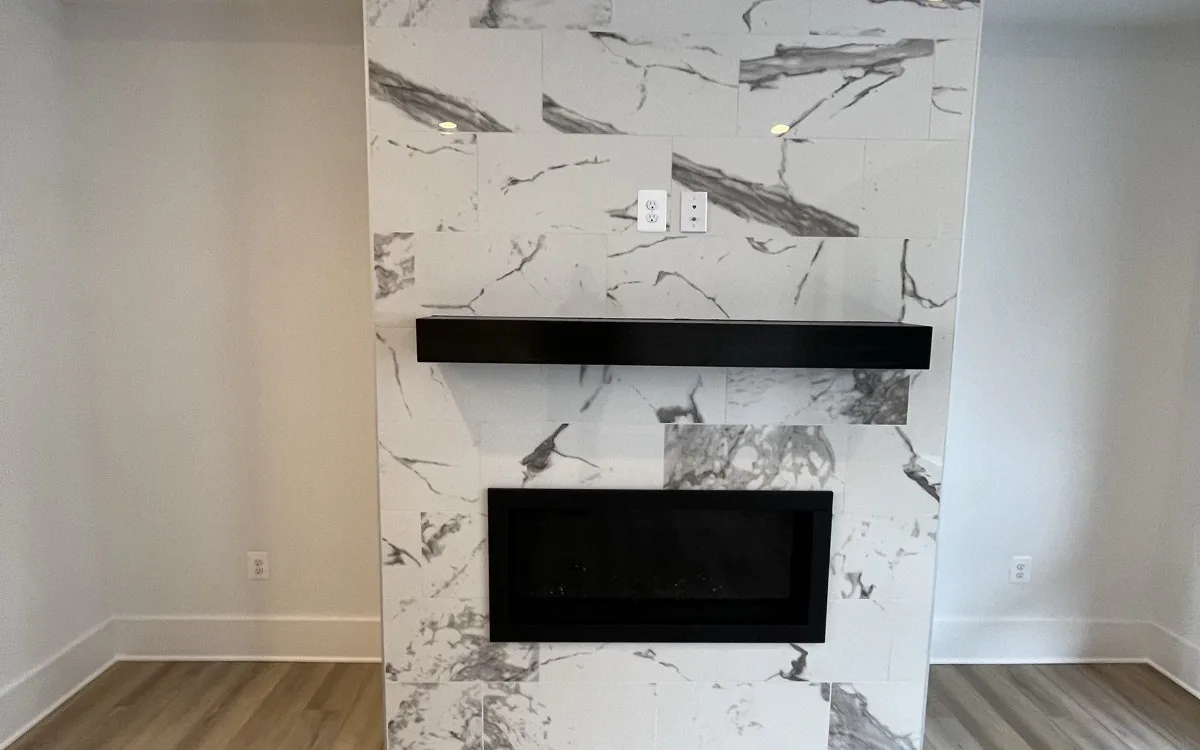
A fireplace surround renovation is one of the highest-visual-impact projects available in a living room, family room, or basement — a single wall treatment that becomes the defining focal element of the space. In the DC, Maryland, and Virginia market, where older homes frequently have outdated brick surrounds or builder-grade wood mantels, and where new builds often include pre-framed fireplace niches awaiting a finished surround, the design-build scope is consistent: a linear gas or electric fireplace insert recessed into the wall, a floor-to-ceiling tile or stone surround, a floating steel or wood mantel shelf, and integrated recessed lighting. Here's how these projects work and what they cost.
Linear vs. Traditional Fireplace Formats
A traditional fireplace has a roughly square or tall-rectangular firebox opening with a projecting mantel surround — a format inherited from wood-burning fireplace construction. The linear fireplace format, which has become the dominant choice in DMV renovations over the last decade, uses a wide, low-profile firebox opening — typically 36 to 72 inches wide and 12 to 18 inches tall — set within a flush wall surface. The visual effect is architectural rather than traditional: the flame is a horizontal ribbon behind glass, and the surround plane is uninterrupted from floor to ceiling.
The format choice has functional implications:
- Linear gas insert: Direct-vent gas inserts are the most common choice for linear fireplaces in DMV homes. They require a gas line run to the firebox location and a direct-vent pipe that runs horizontally through an exterior wall or vertically through the roof. Direct-vent units seal the combustion chamber from the living space — combustion air comes from outside, exhaust goes directly out — which makes them suitable for tightly sealed modern homes and basements where an open-combustion appliance would affect indoor air quality. Most units include an electronic ignition, thermostat control, and a variable-height flame setting.
- Linear electric insert: Electric fireplaces require only a 120V or 240V circuit (240V for larger units) and produce no combustion byproducts — no vent pipe or gas line required. The flame effect is LED-generated and increasingly realistic; the heating output is resistive electric, which is adequate for supplemental zone heating but not whole-room primary heat. The installation simplicity makes electric linear inserts the practical choice for interior walls, basement rooms far from exterior access, and condominiums where gas service or exterior venting is restricted.
- Ethanol (bio-ethanol) insert: Ventless, no gas or electrical connection required beyond a basic outlet for a remote ignition. Burns denatured ethanol fuel. Real flame, real heat, minimal installation complexity. The tradeoff: fuel cost is high for regular use, the flame output is modest compared to a gas unit, and the firebox must be sized for the burner cartridge. Used in high-design residential projects where the venting constraints rule out gas.
Fireplace Surround Design: Floor-to-Ceiling Tile
The floor-to-ceiling tile surround — where the entire wall plane behind and around the fireplace is finished in large-format stone or porcelain — has become the defining visual element of contemporary fireplace renovations in the DMV. The design reads as a single architectural surface rather than a bordered surround, and it scales the fireplace to the full room height. Key design decisions:
Tile Material
- Large-format porcelain (calacatta, statuario, or other marble-look): The most common choice. Porcelain in 24×24, 24×48, or 12×24 formats covering the full wall plane requires bookmatching (alternating tile orientation to continue the veining pattern across joints) or random-lay for a less formal effect. Large-format porcelain is non-porous, requires no sealing, and handles the heat zone directly above a gas fireplace without the thermal cracking risk that affects natural stone. Grout joints are typically minimal — 1/16" or less with rectified tile — which gives the look a near-seamless stone wall quality.
- Natural marble or quartzite slab: A full-height stone slab or bookmatched slab panels produce the most dramatic and seamless result — no grout joints, continuous veining across the entire surround. The material cost is higher, the installation requires a stone fabricator and experienced tile setter, and natural stone must be sealed and maintained near a heat source. The aesthetic return is significant in high-end primary living rooms.
- Textured porcelain or ceramic: Fluted, ribbed, or 3D-surface tile on the surround plane adds sculptural interest. Popular as an accent material on the vertical surround flanking the firebox, with a complementary flat tile on the upper face above the mantel.
- Brick veneer: Traditional fireplace aesthetics with a contemporary edit — thin brick veneer panels in a white, cream, or charcoal finish applied to the surround, with a contrasting steel or concrete mantel. Appropriate for industrial-transitional or farmhouse design directions.
Mantel and Shelf
In a linear fireplace installation, the mantel is typically a single floating shelf rather than a projecting mantel surround. The shelf creates a horizontal line that separates the firebox zone from the display zone above while maintaining the flush-plane visual character of the design. Common material choices:
- Steel or blackened steel: A thick steel plate (1" or more) cantilevered from the wall, with a matte or patinated black finish. Pairs with tile surrounds that have cool or neutral toning — calacatta white, charcoal, concrete-look porcelain.
- Solid wood or hardwood slab: A natural-edge walnut, white oak, or reclaimed wood shelf adds warmth to an otherwise minimal tile-and-steel composition. The wood must be positioned at the code-required clearance distance from the firebox opening — typically 6 to 12 inches above the top of the firebox, depending on the insert manufacturer's specifications.
- Concrete or stone slab: A cast concrete or quartzite shelf as part of a material-consistent composition — matching or complementing the surround tile.
Recessed Lighting in the Surround
Recessed spotlights mounted within the surround — above the mantel, flanking the firebox, or in the ceiling directly in front of the surround wall — provide directed lighting that highlights the tile texture and mantel objects. The integration of recessed lights in a tile surround requires careful coordination: the light housings are framed into the wall before tile installation, and the tile cuts around the trim rings. Low-voltage adjustable downlights (GU10 or MR16 format) with a narrow beam angle are the standard specification for accent-focused surround lighting.
Code Requirements and Permits in the DMV
A linear fireplace installation in a DC, Maryland, or Virginia residence requires a permit in most jurisdictions when:
- A new gas line is run or an existing gas line is extended to the fireplace location
- A new electrical circuit is added for an electric insert or for in-surround lighting
- The firebox opening is modified — enlarging, reducing, or relocating the opening in a framed wall
- A direct-vent pipe penetration is added through an exterior wall or roof
The firebox insert itself must be installed per the manufacturer's clearance specifications, which define minimum distances from combustible materials (framing, tile backer, wood mantel) to the firebox housing. Gas inserts also require inspection of the gas connection. Permit timelines in DC and most Maryland and Virginia jurisdictions run 2–4 weeks for a combined plumbing/mechanical/electrical scope.
Existing Fireplace Renovation vs. New Installation
Many DMV homes have existing wood-burning masonry fireplaces — a brick firebox and chimney that was built with the house. Converting or upgrading these to a gas insert with a new surround involves different considerations:
- Gas insert into existing masonry firebox: A gas log set or a sealed gas insert can be installed directly into an existing masonry firebox, with the vent liner run up the existing chimney. This is a lower-cost conversion that preserves the original masonry opening and chimney; the surround can be updated independently around it.
- Removing the masonry and framing a new opening: For a full linear fireplace redesign, the existing brick firebox and chimney breast may be partially or fully removed to create a flush framed wall with a new linear firebox opening at the design's specified dimensions. This is major construction — structural assessment of the chimney breast may be required in some homes — but it produces the clean flat-plane surround that the linear format requires.
- Overmantel renovation only: In some projects, the firebox itself is left as-is and the renovation scope is the surround tile and mantel above and around it — replacing a dated wood mantel surround with a tile-to-ceiling treatment and a new floating shelf. This is the most cost-effective update and avoids the permit complexity of modifying the firebox or gas line.
What Fireplace Renovation Projects Cost in the DMV
- Electric linear fireplace insert (36"–50"): $800–$2,500 for the unit; installation $300–$600 (dedicated circuit)
- Direct-vent gas linear insert (36"–60"): $2,500–$6,000 for the unit; installation $1,200–$3,500 (gas line, venting, electrical for controls)
- Floor-to-ceiling tile surround, porcelain, standard format: $4,000–$10,000 installed (tile material + labor + backer/waterproofing)
- Floor-to-ceiling natural stone slab surround: $8,000–$20,000+ installed (slab material, fabrication, installation)
- Floating steel or wood mantel shelf: $600–$2,500 fabricated and installed
- Recessed lighting integration in surround (2–4 fixtures): $600–$1,500
- Complete linear fireplace renovation (new insert, tile surround, mantel, lighting): $10,000–$25,000 for a mid-range finish; $25,000–$45,000+ for full-slab surround with premium gas insert
- Existing masonry fireplace demolition and reframe for linear format: Add $5,000–$15,000 depending on chimney removal scope
Ready to Renovate Your Fireplace?
Donya LLC is a licensed and insured design-build contractor serving Washington DC, Maryland, and Northern Virginia (MHIC #159903). Our interior renovation service includes fireplace surround design and construction, gas insert specification and installation coordination, tile work, mantel fabrication, and integrated lighting — all as part of a whole-room or whole-home renovation scope. Call (301) 337-9445 or email Reza@donyallc.com to discuss your project.