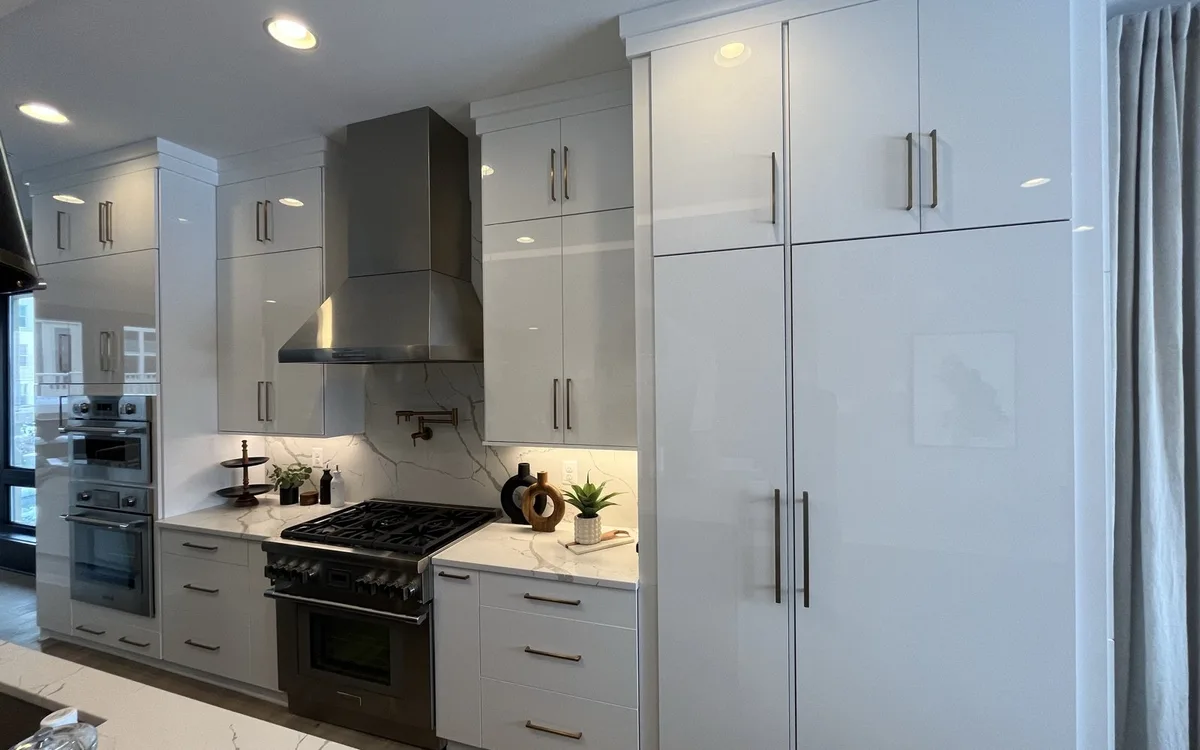
Appliances are typically the last decision made in a kitchen renovation and the first thing visitors notice. They also represent a significant share of the total project budget — $5,000 to $30,000 or more for a full suite — with purchasing decisions that are difficult to reverse once cabinetry is built around them. In the DC, Maryland, and Virginia market, where kitchen renovations frequently exceed $60,000 for a full gut and remodel, getting the appliance specification right is as important as getting the cabinet layout right. Here's how to think through the key decisions.
Ranges vs. Cooktop + Wall Oven: The Layout Decision That Drives Everything Else
The fundamental appliance layout choice is whether to use a freestanding or slide-in range (which combines cooktop and oven in a single unit) or to separate the cooktop and oven into distinct appliances. Both approaches work well; the right choice depends on your kitchen's footprint and how you cook:
- Range (freestanding or slide-in): A single unit with a cooktop on top and one oven below. Standard width is 30 inches; professional-style ranges run 36 or 48 inches. The slide-in format fits flush between cabinets and is the current standard for kitchen renovations; freestanding ranges with finished sides are appropriate where the range sits at a peninsula or island end. The advantage of a range is simplicity — one appliance, one electrical/gas connection, one installation.
- Cooktop + wall oven: Separating the two allows the wall oven to be positioned at a more ergonomic height (waist to shoulder level, rather than at floor level as in a standard range). A double wall oven — two separate oven cavities stacked vertically — requires a dedicated 27- or 30-inch wide column in the cabinet run, typically 84 inches tall to accommodate both units. The practical benefit is having two full oven cavities at the same time, with independent temperature control — useful for large holiday meals. The additional complexity: two installation points, a separate cooktop cutout in the counter, and more cabinet real estate consumed by the wall oven column.
In a DMV kitchen renovation, the double wall oven + separate cooktop configuration has become increasingly common in new builds and high-end remodels. The layout is typically planned from the beginning — retrofitting a wall oven column into an existing cabinet run is possible but adds construction cost.
Gas vs. Electric vs. Induction Cooktops
The cooktop fuel type decision involves both cooking performance and infrastructure:
- Gas: Responsive heat control, works with any cookware, and produces the visible flame that most experienced home cooks prefer. Requires a natural gas or propane line at the cooktop location. In DC and most of Maryland and Northern Virginia, natural gas service is widely available in established neighborhoods; new construction in some jurisdictions may face pipeline connection restrictions as local energy policy evolves.
- Electric (radiant): Standard in kitchens without gas service. Smooth glass surface is easy to clean; heat response is slower than gas and less precise than induction. Requires a 240V circuit.
- Induction: Uses electromagnetic energy to heat the pan directly, not the burner surface — the fastest heat-up of any cooktop type, very precise temperature control, and the cooktop surface doesn't get hot (only the cookware does, reducing burn risk). Requires 240V and induction-compatible cookware (cast iron, most stainless steel, and any cookware that a magnet sticks to). Induction has moved from niche to mainstream in the DMV renovation market over the last five years.
- Dual-fuel: A range or cooktop with gas burners and an electric oven — gas is preferred for stovetop cooking, electric convection is preferred by bakers for oven consistency. Most professional-grade range brands offer dual-fuel configurations.
Professional-Style Ranges: What the Upgrade Buys
Consumer ranges from standard brands (GE, Whirlpool, Samsung, LG) run $800–$2,500 for a 30-inch slide-in. Professional or semi-professional ranges from brands like Wolf, Thermador, Viking, Monogram, Bertazzoni, and Café run $3,500–$12,000+ for a 30-inch unit, with 36- and 48-inch models substantially higher. What does the price premium deliver?
- BTU output: Consumer gas burners typically produce 9,000–12,000 BTU per burner. Professional burners run 15,000–25,000 BTU on the high-output position, which matters for high-heat techniques — searing, wok cooking, rapid boiling. It does not matter for simmering, where a sealed burner with a low-BTU setting performs similarly.
- Oven cavity size and convection performance: Professional ovens are often larger and use more powerful convection fans that move air more consistently across the oven cavity — relevant for baking multiple trays simultaneously.
- Build quality and serviceability: Heavier gauge steel, continuous cast iron grates, and commercial-style knobs. Professional appliances are typically more serviceable than consumer units — parts are available for longer and the units are designed for technician repair rather than replacement.
- Aesthetics: The stainless steel, industrial-kitchen visual character of professional ranges is a significant part of the appeal — and the reason they're often specified as the kitchen's focal element in a renovation.
Ventilation: The Most Underspecified Appliance
Range hoods and ventilation systems are consistently underspecified in kitchen renovations. The visible part of a range hood — its shape, size, and finish — gets significant design attention; the ventilation performance (CFM rating, duct sizing, makeup air requirements) does not. The result is kitchens with attractive hoods that don't effectively move cooking air, smoke, and odor.
Key ventilation specifications for DMV kitchen renovations:
- CFM (cubic feet per minute): The volume of air the hood can move per minute. General guidance is 100 CFM per 10,000 BTU of cooktop output for gas, and 100–150 CFM for every 12 inches of cooktop width for electric. A 36-inch gas cooktop with four 15,000-BTU burners should be paired with a minimum 600 CFM hood.
- External venting vs. recirculating: External venting (through a duct to the exterior) is far more effective than recirculating hoods, which filter air and return it to the kitchen. Recirculating hoods are the only option where exterior duct routing is not feasible (some condos, apartments, or kitchens positioned far from an exterior wall).
- Makeup air: A range hood over 400 CFM on a tightly sealed modern home may depressurize the kitchen when operating, causing back-drafting of combustion appliances (gas water heater, furnace) and making the hood door hard to open. Homes with tight air sealing (common in new construction and energy-efficient renovations in DC and Maryland) may need a makeup air system — a controlled fresh-air intake that operates when the hood runs. This is a code requirement in some jurisdictions for high-CFM hoods.
- Duct sizing: The duct connecting the hood to the exterior must be sized for the hood's CFM output. Undersized or long duct runs — with too many elbows — dramatically reduce effective airflow and increase noise.
Pot Fillers: Practical or Cosmetic?
A pot filler — a wall-mounted faucet at the range, typically on an articulating arm — eliminates carrying a filled pot from the sink to the cooktop. It requires a cold-water supply line run to the wall behind the range, which is most cost-effective during a renovation when the wall is open. Added cost during a renovation: $800–$1,500 for plumbing rough-in plus the fixture itself ($300–$1,500 depending on brand and finish). It is not essential — homeowners have filled pots at the sink for generations — but it is a convenience feature with a relatively low incremental cost when added during a renovation.
Appliance Budget Ranges for DMV Kitchen Renovations
- Consumer 30" slide-in range (gas or electric): $900–$2,500
- Professional-style 30" range (gas, electric, or dual-fuel): $3,500–$8,000
- Professional-style 36" or 48" range: $7,000–$20,000+
- Single wall oven, 27" or 30": $1,200–$4,000
- Double wall oven (stacked, 27" or 30" wide): $2,500–$8,000
- Induction cooktop, 30" or 36": $1,500–$5,000
- Range hood, externally vented, 30"–36": $500–$4,000 for the unit; installation $600–$1,500 depending on duct routing complexity
- Built-in refrigerator (counter-depth or fully built-in): $3,500–$15,000
- Full appliance suite, mid-range (range, hood, refrigerator, dishwasher): $8,000–$18,000
- Full appliance suite, professional-grade: $20,000–$45,000+
Ready to Plan Your Kitchen Appliance Upgrade?
Donya LLC is a licensed and insured design-build contractor serving Washington DC, Maryland, and Northern Virginia (MHIC #159903). Our kitchen remodel service includes appliance coordination, cabinet layout planning for specific appliance specifications, ventilation duct design, and pot filler rough-in — all sequenced as part of a complete kitchen renovation. Call (301) 337-9445 or email Reza@donyallc.com to discuss your project.